We take turban-wearing in 21st Century Britain for granted and, quite rightly, no one bats an eyelid. However, in the 1960s and 1970s it was very different. Borough archivist Dr Jonathan Oates looks back at a time when this key part of Sikh identity eventually led to a change in the law.
Society was changing in the 1960s and, in part, this was because of an increase in the number of people from moving from overseas. Unfortunately, however, attitudes of some locals could be at odds with, or lead to a struggle to adapt to, some of the habits or traditions of the newcomers.
This was partly within the world of work. Many employers insisted that their workforce dress in uniforms. This was the case with the publicly-owned transport services and, in particular, frontline staff had to wear a particular type of cap. This was a problem for turban-wearing Sikhs and, in the 1960s, one Southall man had to go home because he would not wear the stipulated headgear. Although London Transport later created an exemption for Sikhs, not all other employees agreed. At Hanwell bus depot, men came in wearing all sorts of headgear and were known as the ‘Mad Hatters’. Their spokesman said that if Sikhs could wear turbans then they should also be allowed to wear what they wanted.
Another issue arose in 1973 because part of the new Road Safety Act stipulated that all motorcyclists must wear crash helmets or be fined. This led to concern among Sikhs in Southall and elsewhere that they could no longer legally wear their turbans when riding motorcycles. An action committee was formed to protest but others thought that safety should trump religious concerns. Indeed, one man said that turban wearing was a tradition not a religious tenet of the Sikh faith.
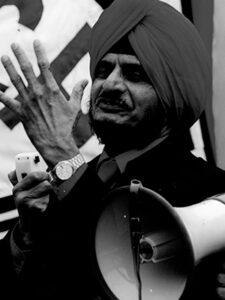
For the first time, in 1974, a man was then fined for riding a motorcycle in Southall. Another man, Baldev Singh Chahal from High Wycombe, was also fined but refused to pay and so spent a month in prison. He also stood as an independent in the February 1974 general election on this issue. Sidney Bidwell, Southall’s MP, took up the issue with the Minister of Transport. Other MPs supported his Private Member’s Bill. It was argued that turbans offered greater head protection than crash helmets did and that, in the 2 world wars, turban-wearing Sikh soldiers had enjoyed a similar protection from bullets.
It was in 1976 that an exemption for Sikhs was granted and Chahal’s fines were remitted. It was seen as a great victory for the Sikhs and for religious toleration in general. However, it is unclear how many people in Southall actually benefited at the time because critics observed that Southall Sikhs preferred the car to the motorcycle as a form of transport.
However, turbans could still sometimes be a problem for local Sikhs. The first councillor in Southall of Indian origin, Sardul Singh Gill, was asked to leave a pub in Greenford because he was wearing a turban (the pub had a non-headgear policy). A non-turban-wearing Sikh died in a scuffle outside a gurdwara for not wearing one. An employee of a meat factory was sacked in 1979 for not wearing company approved headgear and refused to be clean shaven (which is against the Sikhs’ five Ks). Fellow Sikhs marched in his support.
When I was walking towards Southall Railway Station recently, I noticed a turban-wearing motorcyclist deliveryman and wondered if he was aware that 50 years ago wearing what he was, would have been illegal.
Want to know more?
Dr Oates is giving a talk on this subject at The Dominion Centre in Southall on 18 June (5:30pm).