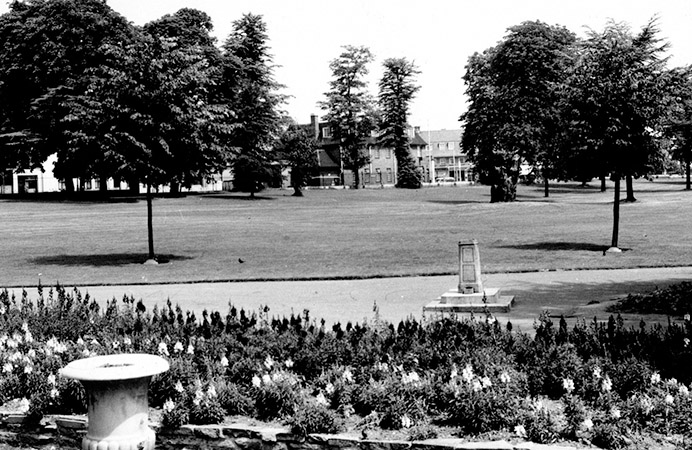
Borough archivist Dr Jonathan Oates marks the centenary of Gunnersbury Park with a look back at the local landmark’s origins and history.
It was in May 1926 that Gunnersbury Park was opened to the public by the Minister of Health, Neville Chamberlain (who was later to become Prime Minister at the start of the Second World War).
There had been a substantial house here since the one built for Sir John Maynard in 1658-1663. ‘Serjeant’ Maynard was a well-known lawyer and led the prosecution in the 1640s against some of King Charles I’s supporters following his execution. Maynard’s career prospered, not just under Cromwell, but also during the reigns of Charles I’s two sons, Charles II and James II. He was knighted for his services.
Maynard’s home was designed as a ‘Palladian’ (or Renaissance-era Venetian) villa by John Webb, a pupil of famous landscaper Inigo Jones. It was the largest house in the district with 44 chimneys. The grounds were equally impressive with the first level from the mansion being 4 grass squares, a small orchard and a kitchen garden. Then there were 2 parallel lakes and, finally, a tree lined avenue.
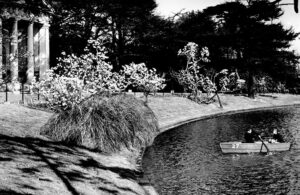
The grounds were remodelled by an 18th Century owner, Henry Furnese. Gone were the lakes and in came the horseshoe pond and the temple, both still there today.
Royalty, in the form of Princess Amelia, bought the estate and, between 1762-1786, it was her summer home. There were lavish social events held here and additional land was acquired as farmland. A private chapel and a grotto were built on the estate. The princess was the unmarried daughter of the late George II. Courtiers and politicians, including novelist and man of letters Horace Walpole, could often be found here.
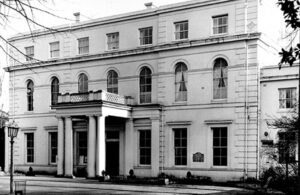
The estate was divided in 1801 between Stephen Cosser and Alexander Copland. The old mansion was demolished. Both men had new houses built. Cosser’s house was Gunnersbury House (the Small Mansion). Copland had Gunnersbury Park House (the Large Manion) built.
After Copland’s death in 1834 Nathan Rothschild bought the estate and, in 1889, his descendants acquired the whole of the now undivided estate. They moved the entrance and had a grander driveway from Pope’s Lane built. His wife Hannah, saw to it that the estate became known for its exotic fruits from the kitchen garden as well as lavish entertainments.
Once again, Gunnersbury became a centre of hospitality for the rich and famous. Among these included Benjamin Disraeli, Queen Victoria’s favourite prime minister. In the early 20th Century, Edward VII and later, his son, George V, visited. In 1917, Winston Churchill was also a guest.
Another Rothschild, Leopold, created a stud on the estate and one of their horses won the Derby in 1879. A Japanese garden was created in the grounds in 1900. But the last Rothschild to live there was Lionel but he left in 1919. The estate was now prime potential building ground with the construction of the nearby Great West Road in the 1920s.
In 1925 Ealing Council applied to buy the estate and Acton Council proposed a joint purchase. There was opposition from Brentford Council which wanted the land to build housing on and a public inquiry was held. It decided there that some housing could be built on the edges of the park but that the majority of the land could be bought by Ealing and Acton for use as a park. It cost £125,000 when the purchase went ahead. A joint management committee was established and, in 1927, this included representatives from Brentford and Chiswick councils.
The estate was now laid out as a public park; with initially a staff of 36. They put in park benches, litter bins, toilets, drinking fountains and sports facilities. The Small Mansion became a tea room and the Large Mansion became a local museum, opening in 1929. Miss Susan Smee, once mayor of Acton, was its first honorary curator.
During the Second World War, around a third of the park was transformed into a heavily-guarded anti-aircraft artillery site, to help protect London from German bombing raids from the air. Some of the grounds were also used for Home Guard exercises. When the anti-aircraft guns were fired, they were so loud that nearby homes shook and windows rattled. After the war, it is believed buildings on the site were used to house Italian prisoners of war for a short time.
In more recent times, the park hosted a visit from Queen Elizabeth II in her golden jubilee year of 2002 and has also been the site of the London Mela festival. There have been restoration work and improvement projects for both the mansions and the grounds in time for the centenary of 2026.