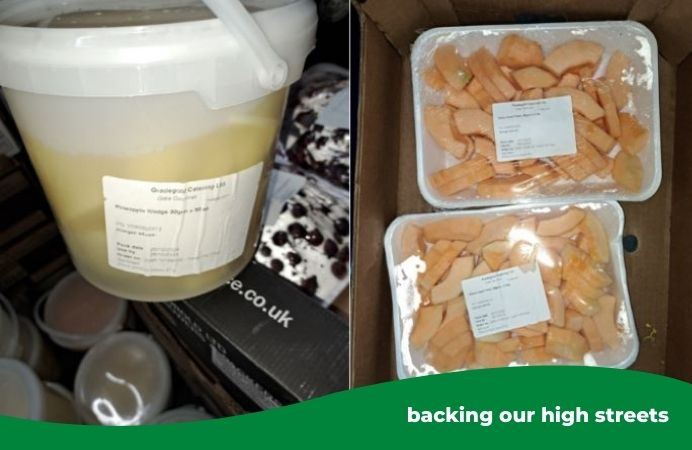
A Greenford food manufacturer has been heavily fined after Ealing Council’s food safety team uncovered serious food safety failings that could have caused serious illness.
Gradegold Catering Limited, of Kelvin Industrial Estate in Long Drive, Greenford, supplies ready-to-eat fruit and vegetables to trade customers, including airline caterers.
On Friday 5 December, Ealing Magistrates’ Court heard that an unannounced inspection by council officers had found that foods were being labelled with false ‘use by’ and packing dates.
The company pleaded guilty to 2 charges: failure to implement procedures based on the Hazard Analysis and Critical Control Point (HACCP) principles and using labels which were likely to mislead as to the quality of the food.
It was fined £20,000 and ordered to pay more than £7,700 in costs and a £2,000 victim surcharge.
Misleading labels and shelf-life risks
The court heard that council officers visited the business in October 2024 and found that products such as lettuce, grapes, melon, and mango were labelled as having been packed on the next day and with illegally extended ‘use by’ dates.
The shelf life of ready-to-eat foods must be strictly controlled to ensure that bacteria does not grow to unsafe levels prior to the ‘use by’ date.
Chilled ready-to-eat food with a shelf life of 5 days or more can support the growth of harmful bacteria such as listeria monocytogenes. The council’s investigation found that Gradegold Catering Limited had not complied with regulations on labelling, increasing the risk that products could become unsafe before their ‘use by’ date.
All mislabelled food was voluntarily disposed of by the business at the time of the inspection, and a follow-up visit found the correct labelling was in place.
The court heard that the offences were likely to have arisen from a deliberate breach of the law. The company had a poor food safety record, with major non-compliance detected during previous inspections.
‘Protecting public health’
Councillor Kamaljit Nagpal, the council’s cabinet member for decent living incomes, said: “Protecting the health and safety of the public is a top priority for us, and in this case there could have been implications far beyond the borders of our borough. We will always take strong action against businesses that ignore the rules and put people at risk. Our food safety team works hard to make sure that resident can trust the food they eat.”
Getting tough
This is just the latest example of the council taking action against local businesses which break the rules.
Frequent enforcement protects the public, with measures ranging from improvement notices to closures and prosecutions closures
Highlights this council term include:
- 6,400 food safety inspections and 26 food safety prosecutions, resulting in close to £500,000 in fines and legal costs
- food safety compliance rates rose from 82% to 88% over the period, reflecting the effectiveness of targeted interventions, education, and enforcement
- seizures of more than 130,000 illicit cigarettes, 75 kg of contraband shisha, and more than 25,000 illegal vapes