
The council is building clever, super-insulated homes that can stay warm in the winter and cool in the summer – without needing central heating. This means low bills, but high comfort.
If you have never heard of Passivhaus, you probably aren’t alone. But this style of building is gaining in popularity all the time – and Ealing Council is leading the way by using it in its new homes.
It is called passive for a good reason. It makes use of your own body heat, and even that of your pets, along with heat given off by things like lights, appliances and other equipment in your home, to keep it warm. Because so little energy is needed, there is up to 90% less need for heating compared to traditionally built buildings.
Ealing Council is now building more than 200 Passivhaus homes across a pair of sites: the first will be ready from May as part of the regeneration of the Golf Links estate in Greenford; and the second is on land between Lexden Road and Steyne Road in Acton and will be ready in the autumn.
The borough is quickly becoming a hot spot for Passivhaus in the UK, with the West London Partnership’s new development on Bollo Lane poised to be the largest Passivhaus programme in Europe.
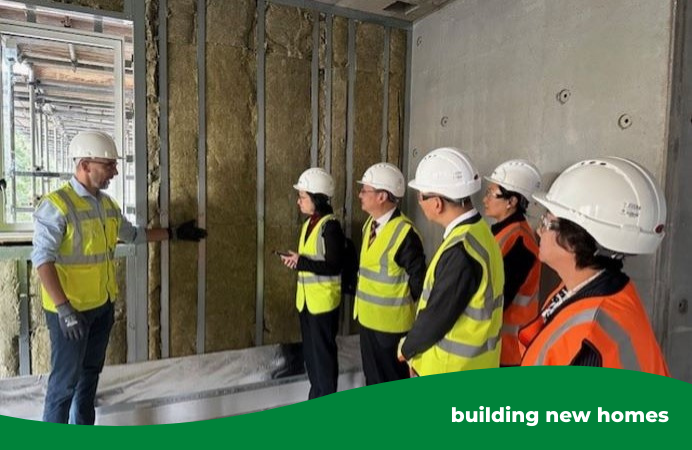
Achieving Passivhaus standards is no mean feat, so a series of visitors came to the borough last year to learn from what the council is doing. This included a delegation from The Chartered Institution of Building Services Engineers, and others from the Shanghai Institute of Technology.
‘Warm, comfortable, low running costs’
Contractors and developers working on new homes with the council are required to meet the high standards set out in the borough’s development guide, which includes achieving Passivhaus.
And all future new council homes in the borough are now likely to meet Passivhaus standards.
Councillor Shital Manro, the council’s cabinet member for good growth and new homes, said: “The Passivhaus construction of our homes means they will be warm and comfortable for their tenants, with exceptionally low running costs.
“What we have already achieved and are on track to complete this year has made a significant contribution towards our ambition for creating more of the high-quality, sustainable housing that local people want. We are proud to be delivering homes that will make a real, long-lasting difference to the lives of our tenants.”
How does Passivhaus work?
Passivhaus homes are built to maintain comfortable indoor temperatures and use very little energy for heating and cooling.
They are airtight to stop heat escaping and draughts getting in, with the maximum possible ‘super insulation’ and triple-glazed windows.
The improved airtightness also means no cold spots, and far less condensation. And ventilation provides a continuous supply of filtered, fresh air.
This means lower energy bills and a home which stays cool in the summer and warm in the winter.
Passivhaus homes often do not need a traditional boiler and radiator heating system. They lend themselves well to air source heat pumps to provide hot water and background heating.
Building new homes