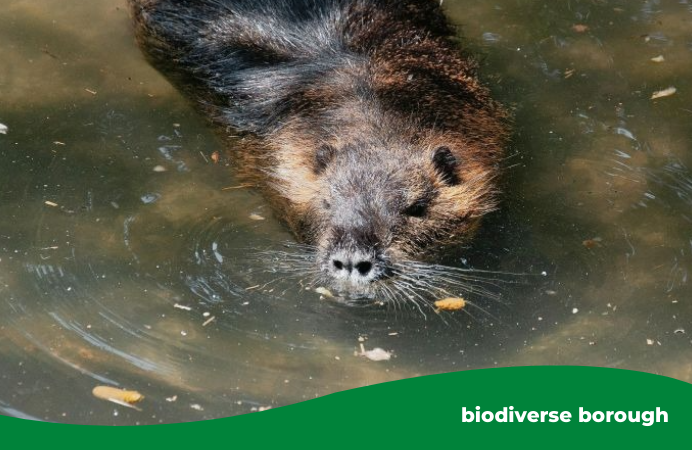
More than 2 years since a group of beavers became Greenford residents, they are making a real impact for wildlife and their human neighbours.
The borough’s celebrity rodents are thriving in their home in Paradise Fields.
The beavers returned to the borough in late 2023 after a 400-year absence in London as part of a monitored 5-year trial. The rewilding initiative, called the Ealing Beaver Project has been led by Ealing Wildlife Group, Ealing Council, Citizen Zoo and Friends of Horsenden. It has been supported by the national Beaver Trust and the Mayor of London.
We visited the beavers on the first anniversary of their arrival and they were already settling in and making an impact. Since then, the beavers have gone on to have 2 kits – baby beavers – in 2024, and another 2 in 2025. One of their kits has even been relocated to Wales to support other rewilding projects.
But, you might ask, why are they so important?
Biodiversity engineers
Europe’s largest rodent, beavers spend their days industriously changing their environment to suit them and feeding on vegetation.
Indeed, beavers are called a ‘keystone species’ for their ability to shape and enrich the areas where they live.
A bustling beaver needs to make sure that the entrance to their home, or ‘lodge’, is surrounded by water, which protects them when they’re entering or resting. To do this, they build their famous dams and dig out new channels to redirect water. But this animal engineering has multiple benefits to the environment.
It may seem destructive, but their chewing of trees helps create habitats for other animals in the area.
The Ealing Beaver Project has recorded 8 new bird species, 2 new bat species, 1 new breeding species of amphibian, and countless new insects in huge numbers since the beavers arrived.
A tree felled by a beaver opens up the opportunity for another species of tree to move into the space, or for smaller ground plants to flourish in the new light previously blocked by a leafy tree. Even the remains of the felled tree become an important environment for insects and fungi as it decays.
This creates a variety of habitats, from wetlands to open areas of grassland, which can support all kinds of insects, birds, and other mammals such as the water vole.
The water vole is endangered in the UK and is locally extinct in the borough, having last been observed here in 2009. They are at risk in part due to reduction in habitat quality, as the riverbanks they live on become overshaded by trees and reduce the plant life they rely on for food and safety.
The reduction of riverbank trees by beavers helps them get a foothold in a rapidly developing environment.
Sean McCormack of the Ealing Beaver Project (and Ealing Wildlife Group) commented that one of the reasons for starting the beaver project was to help improve habitats for a future collaborative water vole reintroduction project, which is now in its very early stages.
You could say that this is all thanks to the beavers.
Helping to soak up floodwater
Beavers even have beneficial effects for the humans that live around them – especially when there are heavy rains like we have experienced at the start of 2026.
Over centuries, historic wetlands that would otherwise have soaked up water or slowed its movement have steadily been built on to make space for human habitation – but, in doing so, it has created a flood risk for those same buildings.
The wetland spaces that rewilded beavers help to reconstruct can reduce the threat of flooding by diverting and capturing rainfall. Conversely, they can also have a similar effect when there’s below-average rainfall too, by preserving the water levels and keeping them steady.
When we visited Paradise Fields, Sean told us the water quality in the area had even been improved thanks to the filtering effect the beaver dams had. The ‘slowing’ effect that beaver dams have on water means that dams ‘block’ pollutant particles from flowing into different areas of water.
He noted that the high flood risk area downstream of Paradise Fields did not flood in the winters of 2024 and 2025 after more than a decade of flooding, while other areas nearby suffered flooding at the same time. Similarly, drought conditions in summer of 2025 were improved as the beavers redirected a brook into the drying up wet woodland, which is a priority habitat for protection in the UK.
‘Positive effect on the area’
Councillor Paul Driscoll, the council’s cabinet member for climate action, said: “It’s great to see the positive effects that the project has had on the area, and the enthusiasm with which people have responded to it.
“It’s incredible to be able to be at the forefront of such important project. It really highlights the support for nature and biodiversity, and the benefits to physical and mental health that nature brings to people too.”
Ealing Beaver Project plans to continue to move young beavers from the project to other rewilding programmes in the country. This happens at the natural point in their lives where they would leave their parents in wild conditions, at around 2 to 3 years old.
Sean McCormack said: ‘We hope that with the recent changes in the law and beaver licensing that young born in Ealing will go out to boost genetic diversity in wild populations across the UK in future, and not just into other enclosures.’
Want to see for yourself?
Beavers are most active at dawn and dusk, meaning that you might have to get up early to see them in action. But if you want to see the evidence of them at work in the area, you can take a self-guided tour offered by the Ealing Beaver Project.
If you feel motivated to help out, Ealing Beaver Project hosts a variety of exciting events and volunteer days to get involved in managing this wildlife hotspot in the heart of London.