Imagine being made to go to a different school further away from your home because of the colour of your skin. For thousands of children in Southall, that is exactly what happened to them in the 1960s.
The practice, which became known as ‘bussing out’, is the subject of an immersive art installation and exhibition at Southall’s Dominion Centre throughout June. It explores the experiences of black and Asian children who were transported on buses across the borough every day. They were sent to schools with mostly white pupils as part of a controversial education policy introduced by the government.
But why did ‘bussing out’ happen in the first place? The original intention was to promote racial integration by capping the number of non-white pupils in individual schools. Instead, however, many of the children faced racism, bullying, and disrupted education after being moved away from their local schools.
What happened in Southall?
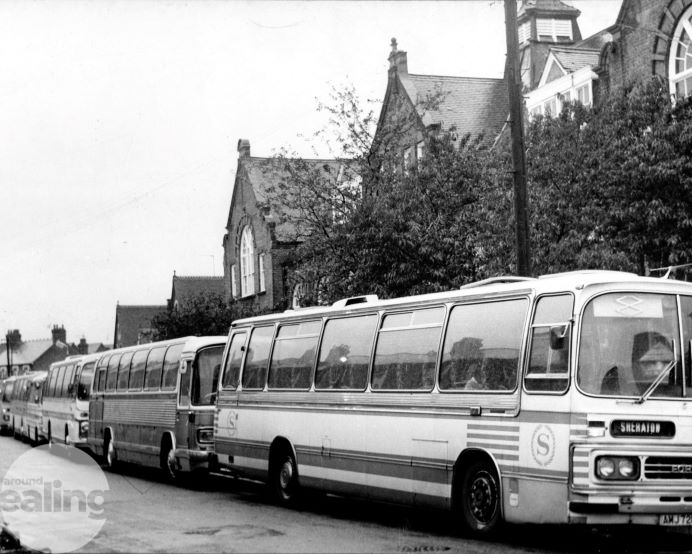
Ealing was the only London borough in which bussing took place. Beginning in 1966, thousands of children – many of which had recently migrated to the UK – were transported on buses daily from Southall to schools across the borough. Many remember the emotional impact of bussing – of feeling herded on to buses and experiencing racism at receiving schools. At its peak, around 3,000 children a day made these journeys.
Ealing Council was one of just 11 local authorities in the country to adopt the policy, which saw thousands of children travel from Southall to schools in places such as Northolt, Perivale and North Ealing between the 1960s and early 1980s.
You can read more below.
The exhibition
The Bussing Out art installation, which opened at Southall’s Dominion Centre on 4 June, is based on research by Dr Shabina Aslam and includes memories from people who experienced bussing out as children.
Southall is the only venue in London that is hosting the exhibition as part of a national tour, and the council’s culture team and borough archivist Dr Jonathan Oates helped to look back at this painful chapter in the borough’s history, including at the fight by activists to end the discriminatory practice.
The exhibition runs until Sunday 27 June. Read more on the Around Ealing website.
Bussing out: how it unfolded
In 1963, Conservative Education minister Sir Edward Boyle visited Beaconsfield Primary School in Southall after concerns were raised about the number of South Asian children in local schools.
Speaking later in Parliament he argues that efforts should be made to prevent schools from becoming ‘only immigrant schools, and that integration was a priority.
He went on to say: “I must regretfully tell the House that one school, Beaconsfield Road School, must be regarded now as irretrievably an immigrant school. The important thing to do is to prevent this happening elsewhere.”
Two years later, the government introduced a policy that advised local authorities to disperse pupils where more than about a third were classified as ‘immigrant children. Ealing Council formally adopted the approach in 1967, setting a 40% cap limit on the proportion of children categorised as ‘immigrant; at any one school.
Supporters claimed this would help children who could not speak English and would improve community integration. Critics argued that it was discriminatory, forcing one community to move rather than encouraging inclusion.
As the policy expanded, children from Southall began making long daily journeys across the borough. Records from Arundell School in Northolt in 1968, describe pupils arriving in tears, struggling to settle, and welfare assistants being appointed to support the children.
By 1970, the council had bought its own coaches, making bussing a routine part of school life. It attracted growing public attention, including coverage on national television.
Growing resistance
Opposition to bussing gathered pace in the early 1970s. By 1972, around 2,200 children were being transported daily. This prompted calls for change from the Ealing Community Relations Council and local campaigners.
Activists such as James Barzey spoke out against the policy, alongside groups including the Federation of Ealing Parents, who argued that the solution was in building more schools in Southall.
In 1973, community worker and civil rights activist Jeff Crawford formally challenged the policy as discriminatory, highlighting its impact on both South Asian and black children.
A year later, more than 100 parents, children and campaigners protested outside Ealing Town Hall, while a petition of 15,000 names was presented to the council’s education committee.
The end of bussing
In the mid-1970s, a report by public policy scholar Dr Maurice Kogan carried out a report for Ealing Council and concluded that the policy was discriminatory.
In 1976, funding was secured for 2 new schools in Southall, with the Race Relations Board at the same time considering legal action against the council.
In 1978 Ealing Council announced that bussing would be phased out. By 1981, it had come to an end.
For many families, however, the impact of those years remained long afterwards. And, for decades, their stories remained largely untold.
Share your memories
As part of the project, Ealing Council’s culture team is looking to speak with residents that experienced bussing out, so that they can record their stories as part of a national oral history project. If you want to learn more about this, please contact Culture@Ealing.gov.uk