Approval for 2 data centres in the borough could bring thousands of new jobs to the area, along with millions of pounds of local investment.
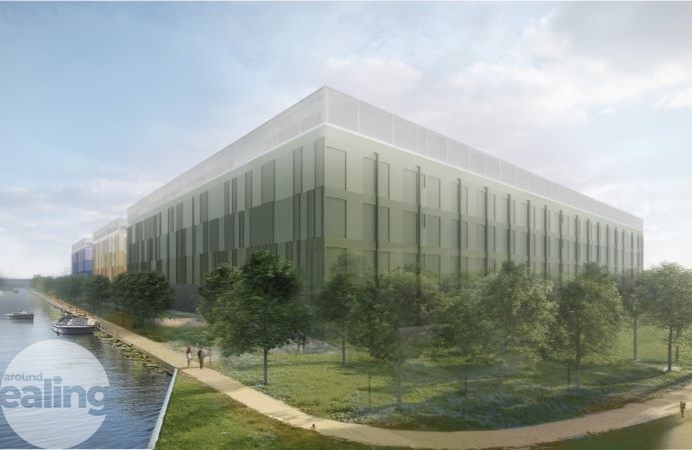
The schemes are both in Southall. One is led by Global Technical Realty (GTR) at the International Trading Estate (CGI image from GTR pictured above), and the other by CyrusOne at the former Honey Monster factory site. Both have been approved by Ealing Council after careful consideration.
Data centres house digital infrastructure that supports services such as online banking, public services, and business operations. They range from relatively small facilities to large-scale campuses. The schemes in Southall are large-scale data centres.
‘Right safeguards must be in place’
Councillor Monica Hamidi, the council’s cabinet member for good growth, said: “We welcome data centres in the right places, if the right safeguards are in place. They must meet strict planning requirements. That means looking carefully at issues such as power, design, jobs, sustainability, and the effect on local people. They must also support inclusive economic growth.
“The GTR and CyrusOne schemes would be major investments in Southall, and both were approved only after the council’s planning committee independently assessed them against planning requirements, including their approach to electricity supply, sustainability, and community impact. We are making sure that the growth these developments bring translates into real benefits for local residents through investment in jobs, skills, and community improvements.”
Why build data centres here?
They form part of wider investment in digital infrastructure across west London.
Both schemes would be built on existing industrial land which had fallen into disuse or needed modernisation. The entire Southall International Trading Estate in Trident Way would be redeveloped by GTR. The current estate includes a mix of industrial buildings and warehouses, some of which are vacant or in poor condition. Meanwhile, the CyrusOne site in Bridge Road was home to the Honey Monster cereal factory from 1937 until production ended in 2016. The factory buildings were demolished in 2022, and the land has sat vacant since.
The council assessed the applications for both schemes on their individual planning merits. In doing so, it considered issues including electricity demand, sustainability, environmental impacts, transport and utility infrastructure, design quality, and the benefits that could be secured for local communities.
How might the community benefit?
This growing data sector supports thousands of jobs across the country, and brings opportunities for schools, colleges, and local businesses.
Through the planning process, the council wanted to have sufficient assurances that both schemes would bring clear benefits to the borough. This included money raised through Section 106 agreements, which are legal agreements that make developers help fund local improvements.
GTR would contribute approximately £20million in Section 106 agreements for its £1billion International Trading Estate project. This would be earmarked to fund a host of community benefits, including a £6million investment in skills training for local people, measures to prevent flooding in the area, and planting 150 new trees. With the reprovision of new industrial buildings and amenities, the site is also expected to create more than 1,000 full-time permanent jobs, including around 775 skilled roles. It is also expected to support 460 full-time construction jobs each year while it is being built.
Meanwhile, the £1.4billion CyrusOne scheme would contribute £17.8million towards employment and skills programmes, including a learning hub and 25 apprenticeships. It would also support improvements to walking routes along the canal and other transport improvements, air quality initiatives, and carbon reduction projects. This money is made up of section 106 obligations of around £9.85million and an anticipated community infrastructure levy contribution of around £7.9million. The development is expected to create more than 1,100 construction jobs before supporting around 650 permanent jobs once operational.
Both schemes would include workspaces set aside to support small businesses, local start-ups, makers, and freelancers with affordable rents.
The council has also prepared a data centre skills and training strategy. This aims to help local people get the skills they need to apply for jobs in the sector.
Beyond their economic value, the developments could help drive wider regeneration in Southall. The council’s refreshed economic vision responds to these changing economic drivers and Southall is well positioned to take advantage of the future growth in the digital sectors. The draft Southall placemaking delivery plan identifies opportunities for investment in Merrick Road and the surrounding area, with the nearby CyrusOne scheme expected to contribute to that transformation.
What about issues with power?
Electricity capacity is a long-term issue across west London. This was considered as part of the planning process for these data centres.
Residents also raised wider environmental concerns about large-scale data centres, including energy demand, cooling requirements, and resource consumption. These concerns were considered by the council when reviewing applications, and have also helped shape the planning obligations and mitigation measures.
The electricity needed for them will not come from the existing local grid capacity. The developers must find and reserve the power they need separately, so it does not take existing capacity away from homes and businesses.
Both sites have allocated space for an energy centre, which could support a future ‘district heat network’. This means heat captured from the data centres could help to warm nearby homes and buildings in the years ahead.
Councillor Dominic Moffitt is the council’s cabinet member for climate action. He added: “We share the concerns that residents have raised about the environmental impact of some data centres.
“That’s why our planning process has insisted on commitments to renewable energy, low-impact cooling technologies, and making better use of waste heat at these sites.”
What happens next?
Like all of the council’s planning committee’s decisions, the planning approvals are subject to standard planning conditions, the finalisation of the Section 106 agreements, and referral to the Mayor of London.
Depending on these being approved, work at the GTR site is expected to start later this year, with the first phase complete by 2030.